

OneSport OT05 Pro Review 2026: Is It Worth €999?
A buying assessment of the OT05 Pro: torque sensing, battery reserve and the compromises to consider.
Read guide
Your everyday journeys, reimagined
Explore electric bikes for everyday journeys. Compare step-through and traditional frames, battery capacity and motor assistance to find the right fit for your daily routine.
Find your city bike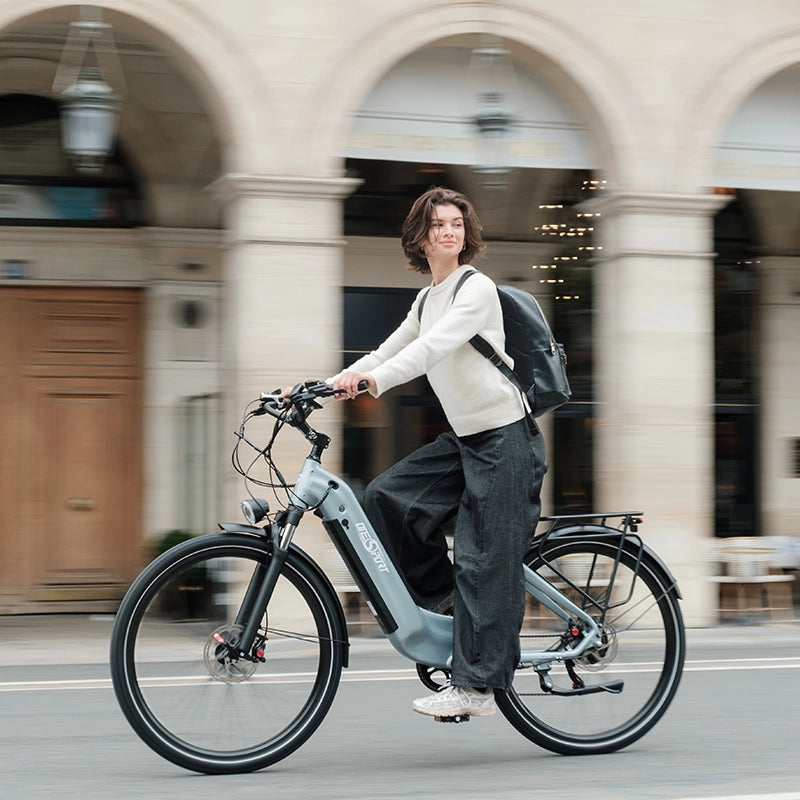
Start with your routine
Low-step frames for easier mounting and dismounting on everyday rides.
Explore low-step bikes ↗ 02Compare the larger batteries against your route and charging opportunities.
Compare battery capacity ↗ 03Motor assistance that responds to how firmly you push the pedals.
Explore torque sensors ↗ 04A traditional frame for daily urban journeys and recreational riding.
Explore trekking-style bikes ↗A buying assessment of the OT05 Pro: torque sensing, battery reserve and the compromises to consider.
Read guideCompare OT05 and OT05 Pro by charging access, frame fit and the demands of your route.
Read guideNo models match these filters.
City & commuter e-bike
Torque-sensor assistance for everyday city riding.
Shown: White / OT05. Other configurations may differ.
City & commuter e-bike
Trekking-style frame for urban journeys and leisure rides.
Shown: Black. Other configurations may differ.
City & commuter e-bike
A low-step frame and practical 13Ah battery for daily journeys.
Shown: Gray / OT12. Other configurations may differ.
City & commuter e-bike
A larger 22.5Ah battery for fewer charging stops.
Shown: Gray / OT05 PRO. Other configurations may differ.
Choose for the way you ride
A low-entry frame reduces the height you need to lift a leg when mounting. That can help with frequent stops, work clothes or a loaded rear rack. A step-over frame offers a more traditional bicycle layout.
Neither shape guarantees a good fit. Check saddle height, reach, standover clearance and whether you can manage the bike comfortably at a stop.
A torque sensor responds to pedal effort; a cadence sensor detects pedal rotation. Both can provide useful assistance, but the controller settings affect how that support builds and stops.
OT05 and OT05 Pro use torque sensing. OT12 and C29 Lite use cadence sensing. Compare the exact configuration, especially when a product offers several versions.
Read Ah together with voltage. At the same voltage, a larger Ah rating means more nominal stored energy, but it does not guarantee the same percentage increase in riding distance.
Plan around your round trip, hills, luggage and charging access. Cold weather, wind and stronger assistance can reduce range. Keep a reserve rather than treating the manufacturer's maximum as a daily target.
Wheel size affects the bike's overall dimensions and handling. Tyre width, pressure, frame fit and suspension also influence comfort on uneven streets.
Consider where you park and store the bike as well as where you ride. Check the model's dimensions and listed weight if stairs or tight entrances are part of your routine.
Warranty coverage varies by brand and component. Review the applicable terms before purchasing.
Delivery to supported EU destinations is normally estimated at 3–10 business days after dispatch. In-stock orders usually require 1–3 business days for processing. Destination, availability and peak periods can affect timing.
Start with frame fit, bike weight and your daily route. Compare battery Ah and voltage, sensor type, brakes and wheel size. Choose enough battery capacity for your round trip with a reserve, and check that you can store and handle the bike comfortably.
The lower frame opening can make getting on and off easier. It does not make every bike suitable for every rider: saddle height, reach, balance and total weight still matter.
Torque sensing measures how firmly you pedal, while cadence sensing detects pedal rotation. Motor response also depends on the controller and assistance settings. Neither sensor label alone describes the whole riding experience.
Compare Ah alongside voltage, then consider the return distance, elevation, rider and luggage weight, assistance level and charging opportunities. A larger battery provides more energy reserve but also needs to fit your budget and handling needs.
They describe results under the manufacturer's stated conditions, usually favourable ones. Actual range varies with terrain, temperature, wind, load and assistance. Do not use one fixed percentage to predict the real range of every model.
Qualifying pedal-assisted bicycles may be treated under bicycle rules, but the exact supplied configuration and your country's requirements determine what applies. A 250W label or a speed setting alone does not prove road-use eligibility. Confirm the documentation and local licence, insurance and equipment requirements before buying.
Commercial warranty coverage differs by brand and component. Consult the Warranty Policy for the applicable terms; statutory consumer rights remain separate.
The current Shipping Policy estimates 3–10 business days after dispatch for most in-stock EU orders, plus normal processing of 1–3 business days. Pre-orders follow their stated dispatch estimate. These are estimates, not guaranteed arrival dates.
Yes, where the model, route and configuration are suitable. Check battery reserve, rider fit, tyres and luggage capacity, and plan charging stops. A city or trekking bike should not be assumed suitable for technical off-road trails.


